

Tenzan Wyspa: power plan for a long outage
Which facilities keep power when the grid is down for days.
- Who it is for
- Councils, emergency services and aid organisations that plan backup power
- Data
- Fictional sites, recorded weather from 2024 (Open-Meteo, ERA5)
- Similar project
- Studio pricing and contact
Three questions to try
What happens hour by hour?
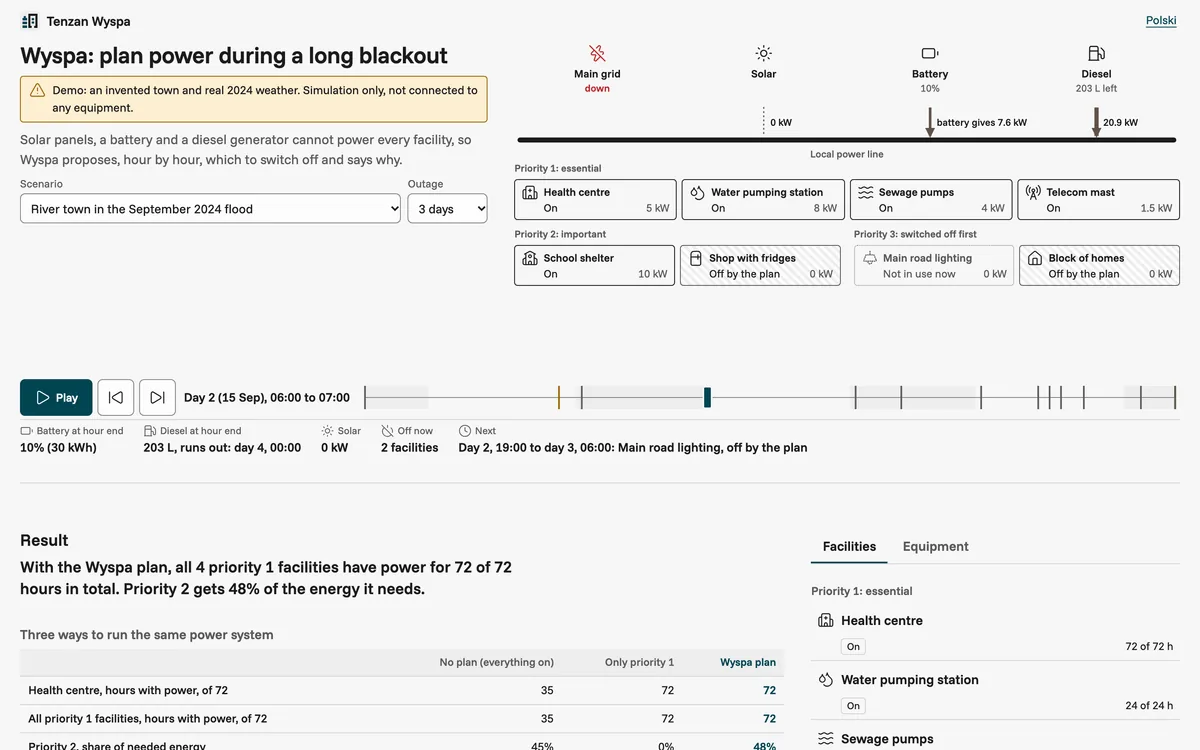
Open the town at its first hour and press Play. The map shows which facilities have power in each hour, and the event list says why the plan switches one off. With the default settings all four priority 1 facilities have power in 72 of 72 hours. Method: the Wyspa engine, river town scenario, default settings.
What if there is no diesel?
Open the town with no diesel. All 400 L of diesel is kept back: the window shows 0 L usable, 400 L kept back, so only the battery and solar remain. The Wyspa plan keeps the health centre powered for 72 h, the only-priority-1 rule for 40 h. All four priority 1 facilities together have power for 12 h with the plan and 40 h with that rule: the plan keeps the top facility on longest and switches lower priority 1 facilities off earlier. With no plan, 11 h. Method: the Wyspa engine, river town, default settings apart from the diesel kept back.
What does it cost to serve the homes first?
Open the town with this setting. The block of homes (priority 3) gets power before every other facility. Priority 3 then gets 74% of the energy it needs instead of 0%. But the health centre and the rest of priority 1 get no power at all (0 of 72 hours): the planner switches a facility on only if the facilities already on keep their power to the end, and the homes alone still lack power in 16 hours. The window marks priority 1 as a problem in red and lists the cost of the override: 7 facilities short. Serving first changes the order only; it cannot create energy. Method: the Wyspa engine, river town, default settings with the homes served first.
From the weather to a plan a person checks
A town cut off from the grid has only its local power system (a microgrid): solar panels, a battery and a generator that power a few facilities without the main grid. Engineers call this running as an island; wyspa is Polish for island. In our model, when all facilities together need more in an hour than the system can give, the whole system shuts down, like a blown fuse. Then the health centre and the water pumps go dark too. Wyspa decides earlier what to switch off, so the most important facilities keep power.
Weather
Hourly sunlight and temperature from Open-Meteo data (ERA5 reanalysis: past weather rebuilt from measurements and a weather model) give the solar output for each of the 72 hours.
Forecast
For future hours the planner takes the recorded weather and lowers solar output by 15%. The current hour uses the actual output.
Priority list
Every hour the planner goes down the list of facilities. It switches a facility on only if every facility already on still has power to the end of the 72 hours. Every switch-off gets a reason.
Human review
The planner only proposes and explains. A person checks who loses power, then prints a briefing; the demo does not switch anything.
The generator starts only when the battery cannot cover the hour. A facility that cannot run is skipped, and the planner still tests the smaller facilities below it. So a small facility of a lower priority can run while a large one of a higher priority is off.
Same result for priority 1; priority 2 costs the diesel reserve
We compare three ways to run the same local power system for 72 hours. Priority 1 is the health centre, water pumping station, sewage pumps and telecom mast in the town, and the medical tent, water purification and communications in the camp.
| Result after 72 h | No plan (everything on) | Only priority 1 | Wyspa plan |
|---|---|---|---|
| All priority 1 facilities, hours with power, of 72 | 35 h | 72 h | 72 h |
| Health centre, hours with power, of 72 | 35 h | 72 h | 72 h |
| Priority 2, share of needed energy | 45% | 0% | 48% |
| Priority 3, share of needed energy | 42% | 0% | 0% |
| Diesel left after 72 h, of 400 L | 4 L | 185 L | 0 L |
| Result after 72 h | No plan (everything on) | Only priority 1 | Wyspa plan |
|---|---|---|---|
| All priority 1 facilities, hours with power, of 72 | 45 h | 72 h | 72 h |
| Medical tent, hours with power, of 72 | 45 h | 72 h | 72 h |
| Priority 2, share of needed energy | 57% | 0% | 48% |
| Priority 3, share of needed energy | 69% | 0% | 0% |
| Diesel left after 72 h, of 250 L | 0 L | 217 L | 0 L |
The Wyspa plan adds energy for priority 2, most of it for the school shelter (which gets 69% of the energy it needs). If the outage may last longer, set "Diesel kept back for later" in the window: with 100 L kept back for later, the plan still keeps priority 1 powered for 72 of 72 hours and covers 19% of what priority 2 needs. Method: the Wyspa engine, river town, default settings apart from the diesel kept back.
Method: the Wyspa engine, 72 hours, each scenario's default settings. An hour counts only when every priority 1 facility got all the power it needed. The energy share is energy supplied divided by energy needed. With no plan, the whole system shuts down, like a blown fuse, in any hour it cannot cover everything. The forecast is the recorded weather lowered by 15%, and the plan knows the outage ends at hour 72. The 15% is an assumption, not a measured forecast error, and the results do not predict how a real site would hold up. These are model results, not measurements of a real outage.
For engineers: the technology stack
| Layer | Choice | What it does |
|---|---|---|
| Engine | Strict TypeScript, no DOM | One-hour steps. The same input always gives the same plan. Tests check the energy-flow rule on cases computed by hand and re-check on the forecast every switch-off made to protect the facilities already on. |
| Data | An Open-Meteo snapshot in the repository | We fetched the weather once with a script. The demo calls no weather API. |
| Power map | SVG and HTML | One drawing of the town: the state of each facility in the chosen hour and the flow from solar, battery and generator. A text table under it gives the same facts. |
| Chart | One SVG | Power served by priority, solar output, battery charge, diesel generator power and switch-offs. A switch-off mark shows its reason on hover or when you reach it with the Tab key. |
| URL state | Query parameters | The address holds the hour, the settings and your choices, so a link opens the same plan. The window reads only known values and ignores the rest. |
| Window | HTML, CSS and TypeScript, esbuild | No framework. Polish and English, full keyboard control, and the plan updates at once when you move a slider or change a priority. |
Sources, scope and limits
What you can do in the window
- Play the outage hour by hour, or jump to the next event.
- Serve one facility before all the others, or exclude it from the plan.
- Move a facility up or down the priority list.
- Change the solar panels, the battery and the diesel tank.
- Pick an outage of 1, 2 or 3 days.
- Keep diesel back for later, or ask how much diesel the plan needs.
- Mark the demo plan reviewed, in your browser only.
- Print a short briefing of the plan.
- Download the hourly data as a CSV file.
- Copy a link that opens the same plan.
Real weather, fictional sites
Two scenarios: a fictional river town over three flood days, 14 to 16 September 2024, with the weather of Kłodzko, and a fictional relief camp over three cold days, 8 to 10 January 2024, with the weather of Suwałki. The town's local power system feeds a few public buildings, a shop, road lighting and one block of homes. The weather comes from the Open-Meteo historical API (ERA5 reanalysis) under the CC BY 4.0 (opens in a new tab) licence. Credit: "Weather data by Open-Meteo
Civil protection and logistics only
Wyspa plans power for civilian facilities in civil protection and humanitarian logistics, such as a flooded town or a relief camp. There are no weapons, no targets and no identification of persons, and the sites and equipment are fictional. The priorities are an assumption, not guidance for real services. Simulation only. Not connected to equipment. Do not use as a switching instruction.
Built around a published challenge
Wyspa is built around the "Energy and Power" challenge published in the NATO DIANA 2026 call. It was not submitted to that call. It is not a NATO project, and NATO has not assessed it.